Queen Isabella II

February 1, 1854
(Wednesday)
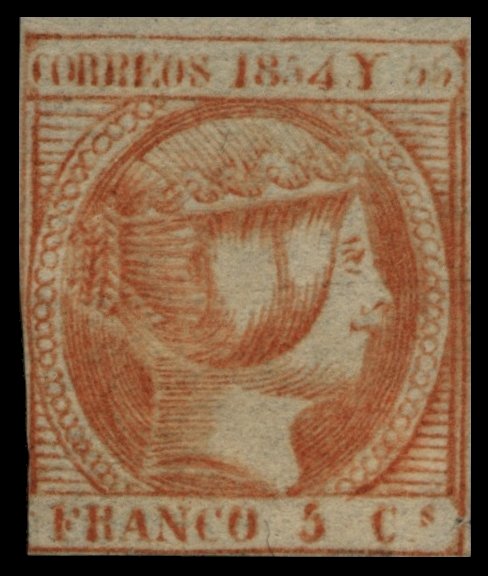
The first official postage stamps of the Philippine Islands,
issued specifically for domestic usage within the interior of the 5-Cuartos. Issued for domestic
mail under half-an-ounce, (single weight interior postal rate). A total of 5,000
stamps, (125 sheets), were printed in shades of orange, pale orange, reddish
orange, and brownish orange. The stamps remained in use until January 1859. (Scott #1; Edifil #1; SG #1) 10-Cuartos. Issued for domestic
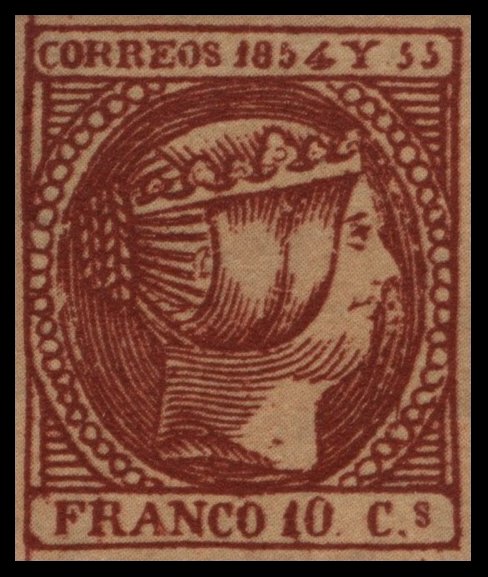
mail between half-an-ounce and one ounce, (double weight interior postal
rate). A total of 5,000 stamps, (125
sheets), were printed in shades of rose, carmine, and dark carmine. The
stamps remained in use until January 1859.
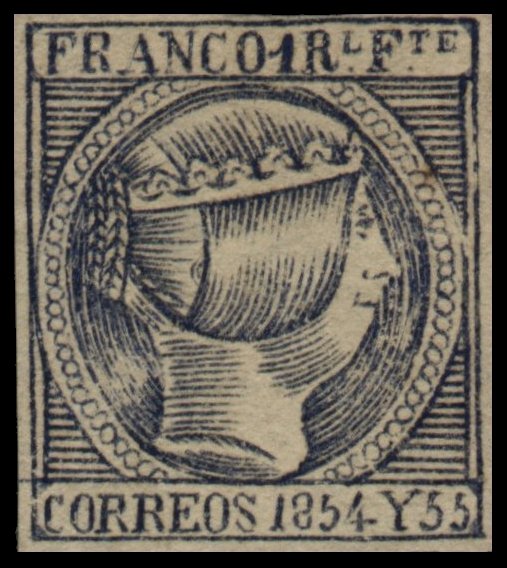
(Scott #2 Edifil #2; SG #3) 1-Real Fuerte. Issued for domestic
mail between one ounce and one-and-a-half ounces, with an extra 10-cuartos
charged for every half-ounce or part of half ounce thereafter. Also used as
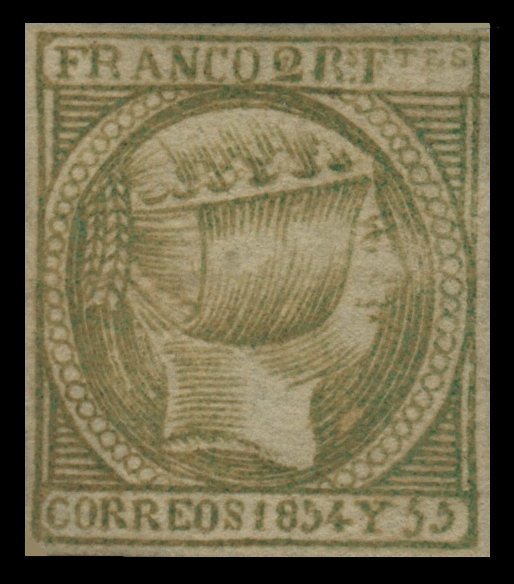
ordinary letter rate to 2-Reales Fuerte. Issued as a
registration fee on mail. There is inconsistency to the exact numbers issued,
indicating that either 2,000 or 3,000 stamps, (50 or 75 sheets), were printed
in shades of green, yellow-green, emerald-green, and olive-green. The stamps
remained in use until January 1856. (Scott #5; Edifil #4;
SG #7)
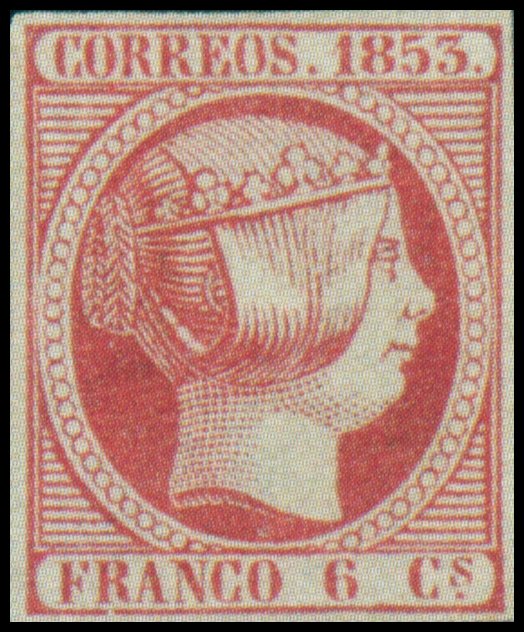
The design of this issue was based on the Spanish stamp of 1853.
The basic differences being the alteration of the date to read “1854 Y 1855”
instead of “1853”, and the change in the value tablets to reflect the local
Philippine currency of Cuartos and Real Fuerte, (with 20-cuartos equal to 1
Real Fuerte).
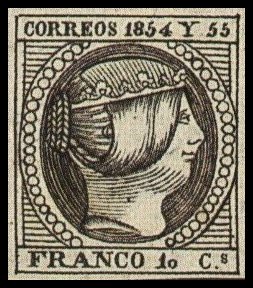
The design portrays the right profile of Queen Isabella II on a
background of fine curved lines, surrounded by an oval of pearls, broken at
the top and bottom by horizontal inscription labels, all in Roman lettering.
The spandrels are filled with horizontal lines. For the 5-cuartos and 10-cuartos values, the upper label bears
the word “CORREOS” (Postage) and the date “1854 Y 1855”; while the lower
label contains the word “FRANCO” (Pre-paid) and the corresponding value. On
the 1-Real Fuerte and 2-Reales Fuerte values, these labels are transposed,
the upper bearing the value, and the lower the date. The stamps were hand-engraved on copper plates in The stamps were Recess printed by Plana, Jorba y Cia
(Comapañia), Plaza de Binondo, A thin line exists around the entire sheet which measures 102mm
x 193mm from border to border. The stamps were issued imperforated on
unwatermarked paper with each stamp measuring 18½ x 21½ mm. The space between
stamps is quite narrow, about 1mm, so that large margins are not to be
expected. The 5-Cuartos and 10-Cuartos values were printed on brittle, thin
to thick white paper; and the 1-Real and 2-Reales on brittle, smooth, thick
yellowish paper. The stamps were crudely drawn providing an unflattering, and
somewhat distorted, likeness of the portrait of Queen Isabella. It was
reported that when the stamps came to the Queen's attention for the first
time, nearly two years after issue, she was shocked and immediately forbade
the continuance of their use on mail to Large blocks or sheets of these stamps exist with circular
dotted cancellations obliterating the stamps. These came from the stock left
in the hands of the Government, and were thus cancelled in this manner to
destroy their fiscal value when withdrawn from circulation. In 1881, the
greater part of the stock then remaining in the treasury was sold to M. J. B.
Moens. It should be noted that the plates used for the printing of all stamps
were, in general, destroyed after the work was completed in order to prevent
illegal printing of the stamps. It was not found altogether easy to introduce the use of postage
stamps in the early days, evident from the following extract from the letter
of Don Antonio Gutierrez, published in Le Timbre-Poste in October 1880: “Having undertaken the office of Director-General of Posts
in the Philippine Islands, at the commencement of 1854, in spite of the
difficulties that my predecessors had encountered in overcoming the obstacles
presented by the character of the people and the indecision of the
Magistrates and Governors of the provinces, who could not make up their minds
to accept the responsibility imposed upon them by Article 2 of the Decree of
December 7, 1853, I succeeded nevertheless, thanks to the goodwill of the
Governors of the Districts and the native authorities, in establishing, from
the month of March 1854, a regular service throughout the Archipelago, with
the exception however of the Marianne Islands, Catandanar, and Batanar, on
account of the want of communications between those provinces and the
capital, Manila; but this irregularity disappeared after a year in the case
of the first two islands and after two years in the case of the third.” It is noteworthy that despite February 1, 1854 being recognised
as the official first day of sale, an article in the Philippine Philatelic
News (Volume 2, No. 6, October – December 1976), makes mention of a block of
four of the 5-Cuartos value with a postmark bearing the date of January 21,
1854. An article entitled ‘Brief History of the Philippines as Portrayed On
Its Stamps’ by Don Pablo Esperidion in the Philippine Journal of Philately
(Volume IV, No. 1, September – October 1951) indicates that the first set of
stamps were issued on January 16, 1854.
PLATES The copper plates used for this issue wore out
rapidly and underwent continual retouches, and in some cases re-engraving, during
the printing process. The retouched plates often produced stamps with coarse
lines of shading on the background around the Queen’s head.
This plate underwent several retouches and
re-engravings during the printing. There are claims that a second plate was
created for this value, producing coarse lines of shading on the background
around the Queen's head, in comparison to the finer lines on the original
plate. However, most authorities doubt the existence of two separate plates,
and believe the coarse lines are due to wear and retouching of one original
plate. 10-Cuartos: Three Plates
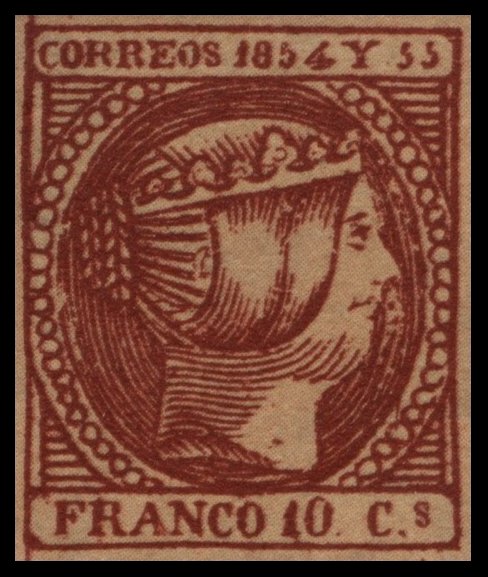
Plate 1 – Black: The stamps were hand-engraved on copper
plates and printed on thin, white, unwatermarked paper. They were printed in
sheets of forty, consistent with other plates, with forty varieties to the
sheet. They were printed with a very small '0' in '10 Cs', and as a result
were never officially authorised. However, some copies were put on sale at
the Post Office before they were withdrawn. This is further supported by a
hand-written letter from the Secretary of the Civil Government of Zambales,
signed by C. Rubio, which reads: “As regards the 1854 stamp, it is perfectly
genuine. Only a few sheets of this, the first issue, were printed, but it was
not approved of, so instructions were given to issue it in carmine. Some of
these stamps were used without authorisation during the few days they were at
the Post Office before the circulation was finally forbidden. The
Governor-General there-upon issued a lawsuit for unauthorised usage.” A large
block is known to have existed, but was cut up, resulting in one block of six,
a couple of pairs and a few singles. Only one postally used copy, tied to
piece, is known; another copy with pen cancel exists. (Edifil #NE1) Plate 2 – Rose: The size of the '0'
in '10 Cs' is corrected and larger on this plate. The engraving of this stamp
is very fine and a fluid ink was used. This plate was neither retouched nor
re-engraved. Stamps only exist with fine lines of shading. Plate 3 – Carmine: Similar to Plate 2,
but engraved with coarser and thicker characters. A thicker ink was used,
which fixed the lines of this plate better. Retouching of one single plate
was carried out on the worn out plate. Stamps exists with fine and coarse
lines of shading.
This plate underwent several retouches and
re-engravings. In the first printings, the color was deep blue, but varied
considerably during subsequent printings, going from dull slate, blue-grey,
very deep ultramarine to deep blue. Stamps exist with both fine and coarse
lines of shading.
This plate was never re-engraved, but some
positions on the plate were retouched. The first printings were in emerald
green which turned to a very pale, bottled-green shade in the later
printings. Stamps exist with both fine and coarse lines of shading.
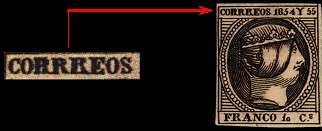
VARIETIES AND ERRORS 10-Cuartos Black (Plate 1). One of the stamps in the sheet of forty was issued with the word
“CORREOS” incorrectly spelt “CORRREOS”. It is not possible to confirm the
position of this error on the sheet, given no full sheet is known to exist.
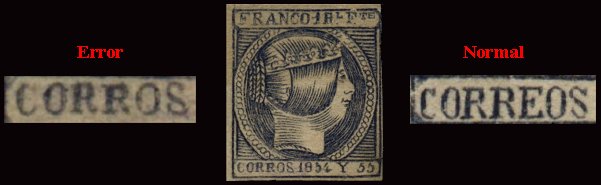
1-Real Fuerte. There is one major variety on the sheet of the
1-real value, which is found on position 26, (first stamp of the sixth row),
where the word "CORREOS" is spelt "CORROS" in error.
Being a constant variety, this error exists on both printings and in each of
the varying shades. (Scott #4c; SG #5a and #5ba; Edifil #3it and #3bit)
ROYAL DECREES AND ORDERS 1853 - 1854 In 1853, the first issue of postage stamps specifically for
domestic use in the To the Governor, Captain-General of the
Your Excellency - A report having been laid before Her
Majesty the Queen, whom God preserve, of the plan under consideration,
relating to the regulations for correspondence within the interior of these
Islands, Her Majesty has been pleased to authorise Your Excellency to arrange
a scheme, after consultation with the Superintendent, upon the following
basis:- 1. There
shall be established a reduced rate of postage for letters circulating within
the said 2. Pre-payment of postage shall be
compulsory. For this purpose, Your
Excellency should make requisition for the number of stamps considered
necessary indicating the prices at which they are to be sold, in order that
these may be impressed upon them. Your Excellency being, in the mean time,
authorised to arrange the best means of carrying out the pre-payment of the
postage. 3. The
service for the conveyance of correspondence will be arranged in such a
manner as to cause as little change as possible in the system in force at
present; laying this duty upon the heads of the provinces, and granting them
a commission of so much percent, fixed by Your Excellency, in agreement with
the Superintendent. 4. And
finally, a certain commission shall be granted, as fixed by Your Excellency,
again in agreement with the Superintendent, to the persons who have to carry
out the transport of the mails, so as to be able to compensate, to some
extent, those who are engaged in this service. By Royal Order
- The Royal Decree of January 12, 1853 was promulgated in Manila
by Governor-General Antonio Urbiztondo y Eguia on December 7 of that same
year in the circular "Circulares e Instrucciones Para el Arreglo del
Poste de la Correspondencia de Estas Islas". The Decree outlines the
Governor-General’s steps for the manufacture and sale of stamps for domestic
use in the Superior Government - General Seat of
the Philippine In compliance with the directions given by Her Majesty, in
the Royal Decree of January 12th last, for the purpose of carrying
out the scheme proposed, and in accordance with the advice of the Assessor
General of the Government, I have decreed as follows: 1. From the first day of
February next year there will be established a charge for postage and
regulations for the conveyance of correspondence within these 2. In the provinces, the
respective chief officers will be charged with the distribution of the
stamps, for which purpose they will receive through their agents in this
capital, from the Post Office Department, the number of stamps considered
necessary for their province. As soon
as the agents have received the stamps, the heads of provinces will become
responsible for their nominal value, and only in case of unpreventable and
fully explained loss or destruction will they be relieved of that
responsibility 3. In view of the
special circumstances of the province of Tondo, and with consent of the
Superintendent, the Administrador de Estancadas (Revenue Department) in that
province will be charged with the sale of stamps there. 4. There is granted, with
the approval of the Superintendent, to the Heads of provinces, and the
Director of the Revenue Department of Tondo, a commission of ten percent of
the value of the stamps sold by them, as remuneration for the expenses caused
by this service, and for the labour and responsibility involved. 5. The Mayors, the
Governors, and the Director referred to above, will communicate direct with
the Post Office Department upon all matters relating to the service, and will
render accounts thereto, at the end of each year, of the stamps on charge,
with a receipt for the amount of stamps sold. 6. For the present, on
account of the additional work caused by this service to the heads of
provinces, they will not be required to furnish securities; but the Director
of Revenue of Tondo, being in a different position, will be required to do
so, and the amount will be fixed by the Post Office Department in accordance
with the extent of the service. 7. Official
correspondence will be conveyed free, and the covers will bear an impression
of a handstamp in black, with or without the Arms, indicating from what
official and from what province the packet emanates. 8. The official
correspondence of the following officials will be mailed by using their
respective stamps: the Superior Government and the General Seat of the
Philippine Islands; their Excellencies Archbishops and Bishops; the Regent
and Fiscal of the "Real Audiencia"; the General
"Intendente" and Superintendent of Royal Finance; the Accounts of
the Army and Finance and of the "Tribunal Mayor de Cuentas"; the
general Administrators of "Rentas Estancadas y Tributos"; the
Administrators of Sub-delegates in the Provinces; the general Commander of
the Navy; the "Ministro Interventor del Apostadero"; the
Sub-inspectors of all Arms; the General Commander of the
"Resguardo"; the Commander of the Public Security; Army Health
Consultant; the Mayor of the provinces, Governors, Lieutenant Governors and
the District Commanders; the General Administration of Posts. 9. The superior chiefs
of the dependencies will see to it that the proper authorities, officials and
chiefs are furnished as son as possible with a supply of the above mentioned
stamps as may be needed. 10. When the employees
and army officers not included in the franchisement, but are eventually
engaged in the service, will have to write on the back of the sheet of paper
addressed to the authorities concerned the nature of their work and the
Province where they are stationed with their signatures at the bottom. 11. In case any Chief of a
province is not provided with his corresponding stamps by the 1st
of February of this coming year, his official correspondence may be treated
in the same manner as those designated for the employees undertaking eventual
work. 12. For the transmission
by post of legal papers of various kinds, reference should be made to the
general regulations of the service, Articles 6, 7, and 8 of Title 19.
Consequently, these packets should be prepaid at the charge of those
concerned, except in the case of official processes or actions between
persons known to be poor; in such case, the circumstances must be certified
on the cover of the packet by the Clerk of Court with the approval of the
Judge. Let this order be known to all those concerned by means of
printed copies of the above mentioned rules and regulations which will also
be served upon all authorities and corporations and later published in the
Official Bulletin giving information to the Government of Her Majesty with
the testimony of this decree. Manila, December 7,
1853. Signed: Urbiztondo The preliminary instructions for the establishment of the postal
charges and prepayment of postage on correspondence within the Philippines,
issued on December 7, 1853, indicated that compulsory pre-payment of postage
was to be established from February 1, 1854. Preventive Rules for the establishment
of postal rates and prepaid postage on mail-matters within the Superior Government - General Seat of
the Philippine Article 1. Let
there be established beginning February 1, 1854, compulsory prepayment of
postage upon all correspondence circulating within the Article 2. From
the said date, no letter will be transmitted which has not been previously
pre-paid by means of a stamp or corresponding postmark with the rate
required. Article 3. For all
the operations of the Post Office, letters will be separated into single and
double. A letter will be reckoned as
single which does not reach half ounce in weight. All others will be reckoned as double. Article 4. Both
single and double letters may be dispatched in two ways - Prepaid or Prepaid
and registered. Article 5. Letters
will be prepaid, if single, at the rate of five cuartos, and if double at the
following rates: those that weigh eight adarmes (half-an-ounce) inclusive,
but not exceeding one ounce, ten cuartos; those that exceed one ounce, one
real fuerte; and so on, the rate increasing by ten cuartos for each amount
exceeding half an ounce. Article 6.
Registered letters must also be prepaid, and in addition to the required rate
of postage, they will be charged two reales each for registration,
irrespective of their weight. Article 7. Letters
circulating within the limits of each Administration or province will be
charged the same rate as that fixed by the general tariff. Article 8.
Newspapers and other periodical publications will be charged by weight, at
the rate of two pesos (16-reales) an arroba (per 25 pounds), provided that
they conform to the following four conditions: 1. They must be delivered to the Post Office direct from the
publishers. 2. That they be sealed with wrappers. 3. The wrapper must bear the name of the newspaper or
periodical. 4. They must contain neither letters nor anything else in
manuscript besides the name and address of the subscriber. Article 9. Printed
matter of all other kinds, with the exception of books (including those that
may be published in parts periodically), will be charged also by weight, at
the rate of nine pesos an arroba, provided that they conform to the following
four conditions: 1. They must be delivered to the Administration of Posts by
their producers, publishers, or proprietors. 2. That they be sealed with wrappers. 3. On the wrapper must be printed the name of the producer,
publisher or proprietor. 4. They must contain neither letters nor anything else in
manuscript except the name of the addressee and his address. Article 10.
Newspapers and other periodical publications, with the exception of books,
when delivered in wrappers and containing neither letters nor anything else
in manuscript but the name and address of the addressee, will be charged five
cuartos each, if they do not exceed one ounce in weight, ten cuartos up to
two ounces, and so on, increasing by five cuartos for each excess of weight
over one ounce. Article 11. The
same rate of postage will be charged for samples of merchandise, of no value,
enclosed in wrappers such as to allow of its being ascertained that they do
not contain any manuscript note, other than invoices and marks. Article 12. Books,
periodical publications, printed matter and samples of merchandise, which are
not included under Articles 8, 9, 10 and 11, will be charged at the same rate
as letters. Article 13. Like
the printed matter treated in Article 9, as well as books, only weight in
arrobas is permitted and means of common and ordinary transporting is allowed
after giving preference to correspondence and newsprints. Article 14. The
pre-payment of postage and registration fee of letters, and also the
pre-payment of postage on newspapers and printed matter posted separately,
and not by their publishers, must be indicated by means of stamps in
accordance with the regulations relative thereto. Article 15. The
pre-payment of newspapers and other printed matter, delivered at the Post
Office by the publishers, will be verified at the Administration by means of
the stamp designated for that purpose. Article 16. No
person will be obliged to accept letters that may be addressed to him, other
than those which he may select before opening them. Article 17. Any
person, corporation, business house or establishment will be permitted to
impress upon the outside of letters a rubber stamp indicating by whom they
are dispatched. Letters thus marked,
which for any reason cannot be distributed, will be returned to the person
named in the rubber stamp. Article 18. Closed
(or sealed) letters transmitted from one place to another, although not sent
by the post, must nevertheless have affixed to them the stamps corresponding
with the postal rate; otherwise they will be regarded as contraband, and will
render the carriers liable to the penalties laid down in Article 20 of the
General Decree for the Postal Service. Instruction for the
postage and registry of letters and for the postage of periodicals, books and
other printed matter, and of samples of cloth in the domestic mails of these
Islands. Beginning February 1, 1854, pre-paid postage will be
compulsory on all correspondence which circulates within the Archipelago
whether sent from one province to another or between towns of the same. That, beginning the said date, any person desiring to send
a letter as well as to register it should indispensably use stamps which are
sold one by one or any number that the buyer may so desire at the stations of
every town designated by the Chief of the province, except in the Capital and
its suburbs where sales will be in the 'tercena' and 'estanquillos' (general
stores). The stamps are made of paper; the bust of Her Majesty the
Queen is printed on them and at the back they have gum to stick them with by
dampening. Mailing of Letters One desiring to mail a letter needs only to affix on the
envelope one or more stamps according to its weight and drop it in a mail
box. If the letter is less than an ounce in weight a stamp of 5-cuartos is
affixed; from half an ounce to less than one ounce, a stamp of 10-cuartos or
two stamps of 5-cuartos each are affixed; from an ounce to less than an ounce
and a half, a stamp of 1-real or two stamps of 10-cuartos each are affixed;
if it is more than an ounce and a half, a stamp of 1-real and another of
10-cuartos or its equivalent are affixed, and so on, increasing 10-cuartos
for every half an ounce in excess. For letters mailed in this way, the addressee need not pay
anything but if the sender fails to affix the necessary stamps on the
envelope according to its weight the addressee will have to pay for the
shortage and failing to do so, the letter is filed in the office. No refund of any kind will be made of excess postage nor
complaint entertained for the recovery thereof if more stamps than necessary
were affixed on the letter. In the general Administration of the Post Office, there
will be an employee to take charge of informing the public as to the weight
of the letter and the corresponding stamps to be affixed, which will be
supplied in the same office. As soon as a letter is received, the General
Administration of the Post Office will see to it that the stamp or stamps
affixed thereon are invalidated by having the same cancelled with a stamp
canceller. The Administration will not transmit in the mails a letter
having a used stamp already affixed on it. Postage on Periodicals, Books and
Other Printed Matter and Samples of Merchandise The dailies and other newspaper as well as other printed
matter of any kind except books, meeting all the requirements prescribed in
Articles 8 and 9 may be mailed in the Administration by affixing stamps
designated for the purpose, when presented by the editors' offices or by the
firms, editors or proprietors. For mailing periodicals, dailies and other printed matter
not included in the previous ruling and for mailing books and samples of
merchandise, the same rules will be followed as those for affixing stamps. Registered Letters One desiring to register a letter must affix the
corresponding stamps for mailing besides paying two reales as registry fee,
not withstanding its weight, and instead of depositing in the mail box as in
the case of ordinary mails it is presented to the Administration of the Post
Office for the issuance of a receipt. The Administration will not accept any
letter unless it has all the stamps corresponding to its weight. For example: To register an ordinary letter, it s
necessary to affix one stamp of 5-cuartos for postage and another one of
2-Reales for registration. Affixing only one of these two stamps is not
acceptable. The stamps on registered mails will be cancelled in the
same manner as those on ordinary mails. The receiver of a registered letter
needs only to return the envelope with the signature of the addressee. Rubber Stamps Any person, corporation, business house, or establishment
has the right to stamp on the envelope of the letters a rubber stamp
indicating the name of the sender. This rubber stamp should be placed on the
reverse side of the letter above the sticker or else on the sealed wax. No change is for the present contemplated in
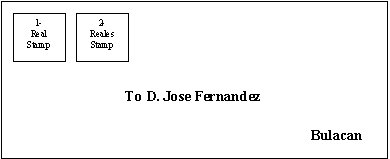
the mailing of correspondence for the Peninsula via the Sample
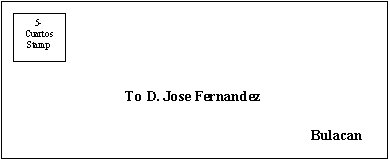
indicating where to affix stamps for pre-paid and registered letters: Pre-paid letter weighing less than half-an-ounce
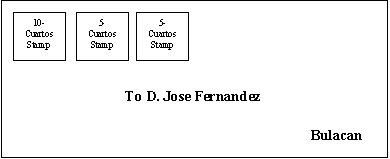
Pre-paid letter weighing more than one ounce but less than
one-and-a-half ounces
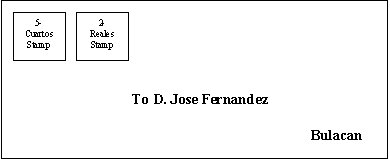
Pre-paid and Registered letter weighing less than
half-an-ounce |


Comments and Feedback Always Welcome .... Please Email
Return to Home Page