Queen Isabella II

January 1, 1856
(Tuesday)
|
|
|
|
||||||||
|
1-Real Plata Fuerte. Issued for single weight overseas
letter rate to 2-Reales Plata Fuerte. Issued for double weight overseas
letter rate to
Stamps were printed and issued in the A circular dated September 27, 1854 from the Postmaster-General
in Madrid specified overseas postage rates of 1-real for either a single or
double weight letter and a rate of 2-reales for registered letters of any
weight. A Royal Order from The currency was changed to 1-real plata fuerte and 2-reales
plata fuerte, and the stamps were issued specifically for overseas mail. They
were engraved by Jose Perez Varela and printed on rough, medium to thick
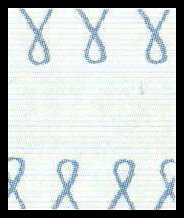
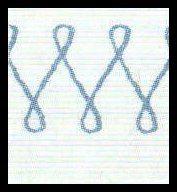
bluish wove paper. The stamps are watermarked "loops", and have the
distinction of being the first and only officially watermarked stamps of the
whole Spanish era. They were typographed by the Fabrica Nacional de Moneda y
Timbre, The use of these stamps was officially discontinued as a result
of a Royal Order issued in November 1864, authorising the withdrawal of all
old stamp issues. However, later usage is known, probably through use of
supplies in remote offices in the interior or in the possessions of private
individuals. From January 1856 to January 1864, these were the only stamps
accepted on mail leaving the
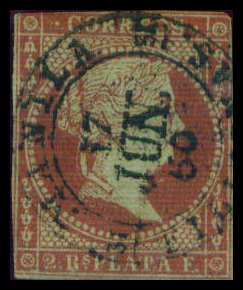
IDENTIFIABLE PHILIPPINE POSTMARKS As the 1 real and 2 reales stamps were in simultaneous use in
the BAEZA CANCELLATIONS
The Small Baeza (left) and Large Baeza
(right) cancellations were applied in either blue or black. Both values are
known with this cancel directly applied on the stamp. Covers also exist where
the stamp is tied with a Parrilla cancel, and the Baeza departure
cancellation applied adjacent on the cover. CIRCULAR DOTTED CANCELLATION
A very scarce cancellation, and until recently,
not recorded used on this issue. This cancel was not in use in “
The most commonly applied cancellation
on cover for this issue. Found on covers where stamps are tied with a
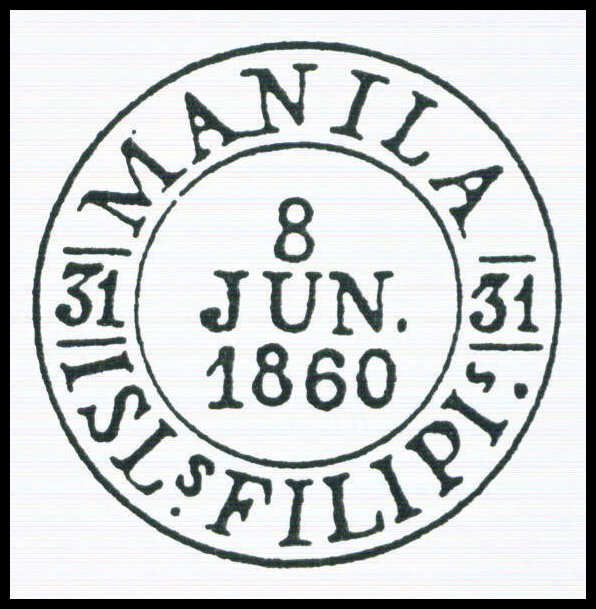
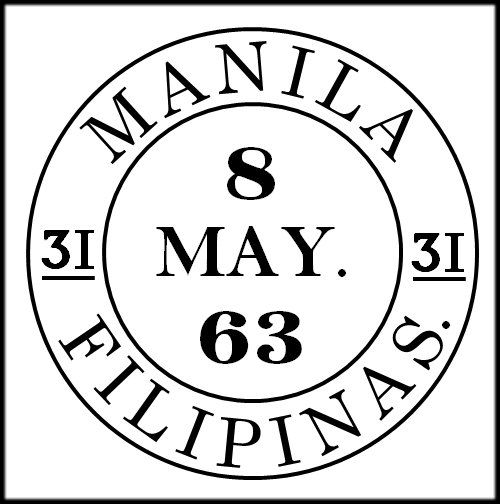
Parrilla cancellation, and the ‘ “MANILA – STAR” CIRCULAR DATE STAMP
Not known to exist tied directly to the
stamps, but probably exists. Known on covers, with the date stamp applied
adjacent to the stamps which are tied with a Parrilla cancellation. A scarce
cancel used from 1860. TOWN CANCELLATIONS
Applied as departure cancellations in PARRILLA CANCELLATION
Although the Parrilla is the most
commonly applied cancel on this issue, it does not uniquely tie the use of
these stamps to the
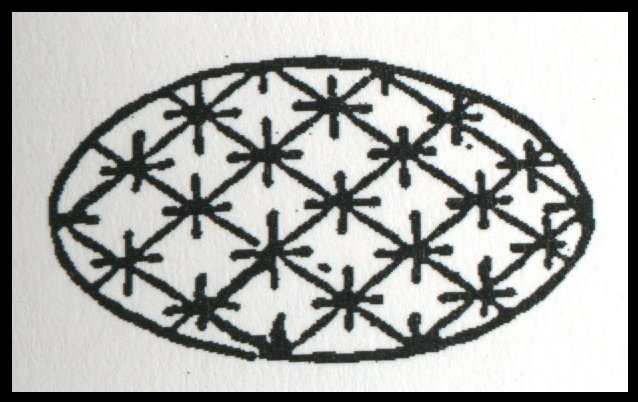
WATERMARK VARIETIES The Loops watermark, which is a continuous design throughout the
paper, is known to exist in two varieties on stamps sent to the There is a further watermark type known on stamps sent to
ROYAL DECREES AND ORDERS 1856 A Royal Decree was issued in Your
Majesty: Simplifying administration introduces morality into it,
and centralizing its funds introduces sound and prudent management into it.
Based on these principles, the undersigned Minister of Your Majesty has the
honour to submit to your wise judgment the draft of a significant and radical
reform in the postal service. When prepayment of correspondence by means of stamps was
established, with the issuance of the said stamps being entrusted to the
Ministry of Finance, Your Majesty's purpose was to simplify accounting
procedures, to centralize funds and to eliminate deplorable abuses completely,
some of which existed, while others were merely assumed, either as a result
of plain malice or of misconceptions born of ignorance. Those important
objectives were partially fulfilled, but it is now time that they are
achieved completely by making prepayment compulsory instead of voluntary, as
is the case today. That public opinion is prepared for such a notable reform
is clearly proven by the fact that today no more than one in five letters
circulate without having prepaid postage; the figure is only one out of
twenty in centres of commerce and of industrial production. Thus, the undersigned does not see any reasonable obstacle
that should make him abandon an idea that, if brought to fruition, would enable
him to propose shortly to Your Majesty and reform of great moment with
respect to the method and the personnel of the postal service. The truth is that in practice this reform, as is the case
with all innovations, presents difficulties rather than positive
disadvantages; but it is also true that any administration that takes fright
when faced with obstacles, condemns itself to immobility, which ultimately
amounts to death. It is objected to the project submitted for Your Majesty's
approval firstly that in two enlightened and advanced countries - England and
France - the Government has not ventured to go so far; and secondly since it
is difficult to supply small towns and isolated villages with stamps,
considerable confusion in public correspondence will result from the reform. The first argument, assuming it deserves such a term, Your
Majesty, is of little importance, in the opinion of the undersigned, if the
measure is in itself desirable and beneficial to all. What does it matter if
in other countries, no matter how advanced they may be, such a reform has not
been implemented? In those places there may be, and there will certainly be,
reasons why something is not done; in other countries, the very thing
proposed to Your Majesty is being done, as this is what the public good and
morality in administration obviously demand. As regards the supply of stamps, the response is even more
obvious. Tobacco, a commodity that is the object of a state monopoly and yet
is widely consumed, is available everywhere. Thus, stamps can be made
available in the same manner and by the same agents. But this is not all,
Your Majesty. Your Majesty’s Government stimulates the zeal of those who sell
tobacco by means of a reasonable premium, as well the interest of individuals
through a discount that is offered to all when they purchase a certain number
of stamps. Criminal sanctions imposed on the negligent seller, and the
possibility given to individuals to send their letters whenever no stamps are
available at the point of origin, round out the system, and triumph over all
objections. Some other minor difficulties are resolved by the draft decree,
to which the undersigned refers Your Majesty, in order not to weary Your
Majesty's attention unnecessarily. Nevertheless, the request is ventured here that Your
Majesty deem fit to turn her attention for a moment to the part referring to
the circulation of printed matter, newspapers, and delivery of all kinds of
works. The broad and constant protection that Your Majesty and
Her Government grant to the free expression of ideas and the propagation of
culture have created for the Spanish printing industry a privilege, if one
may call privilege something that ultimately redounds to the benefit of all.
However, portage by weight, in the present state of affairs, creates serious
vexations, for businesses as well as for the Administration. The undersigned Minister believes that he has found a way
of preventing such difficulties, while preserving the printing industry's privilege
and freeing the administration of a burden. This can be done simply by
replacing portage in Post Offices with the use of seals that indicate price
according to weight and that are to be stamped on packets of letters. In this manner, a newspaper with a seal affixed to it will
enter the letter-box as an ordinary letter, and reach the public, since it
can circulate anywhere and can travel any distance without fulfilling any
requirement other than that of bearing the seal. By virtue of these considerations the undersigned has the
honour to request reverently that Your Majesty deem fit to give her Royal
approval to the following draft decree. Royal Decree: Taking
into account the considerations that the Minister of the Interior has
presented to me in accordance with the Council of Ministers, I hereby decree
the following: Article 1. Public correspondence shall be prepaid by means
of stamps in the Peninsula and the adjacent islands as from 1st June of this
year, and in the Article 2. From the said dates, letters that are mailed
without postage stamps shall not circulate. However, the postal office in
which they originate shall make them known to the public by means of lists of
notices in the Gazette and in official newspapers, and shall inform the
interested parties by means of printed letters if their destination is known. Article 3. The right to sell stamps officially shall be
extended to all points of sale of tobacco and salt, including those points of
sale that are established in uninhabited places; to all offices of the Postal
service and letter distribution centers; and in general to any person who
wishes to take charge of their sale. As from 1 July, there shall be premium
for sale of up to 6 per cent, with a lower premium in major towns and a
higher premium in less populated towns, according to the following schedule:
1% to district administrators who are distributors, and 3 per cent of their
sales; 2 per cent for sellers in Madrid and 3 per cent for sellers in
provincial capitals; 4 per cent in the district capitals and 3 per cent in
the other district towns and other points of sale. Article 4. When stamps are not available at the point of
sale, the sender shall present himself to the Mayor of the town, or to his
representative, and in the absence of either, the Secretary of the town, who
shall write on the reverse NO STAMPS AVAILABLE and then sign it. The name of
the town and the province to which the town belongs shall be put on the date.
Letters endorsed in this manner shall circulate free of charge, and the
seller shall pay two points of the value of the postage. When the lack of
stamps is attributable to the fault of the provincial or district
administrators, they shall pay four points of the value of the postage. Article 5. As from the said 1 July, seals shall be
established and used for newspapers at the rate of 30 reales per 25 pounds,
and the newspapers stamped in this manner may circulate free of charge
through all postal routes. A newspaper that does not comply with this
requirement shall not be allowed to circulate. Article 6. Delivery of printed matter shall be subject to
the present rate of postage, at the rate of 40 reales per 25 pounds [arroba].
The exact amount shall be paid in postage stamps and not in cash. Article 7. When the number of packets of letters on which
a seal has to be stamped does not exceed one thousand per 25 pounds, the postal
office shall charge a fee of 30 reales vellon. From one thousand one to two
thousand packets per 25 pounds, 4 reales shall be added to the 30 reales. The
same amount of 4 reales shall be charged for costs for every one thousand
packets or less. Article 8. Stamping by means of seals shall be established
in Article 9. The seal shall be stamped in a corner of the
paper, and firms shall ensure that the seal is visible after the newspaper
has been closed when it is presented to the Post Office. Article 10. The Ministers of Finance and of the Interior
shall be responsible for implementing the present Decree in matters that are
within their competence; to this end they shall issue the appropriate
instructions. Done
at the Palace and initialed by her Majesty. A Royal Order dated March 5, 1856 was issued, approving the
adopted measurements and penalties imposed in connection with the sale of
postage stamps. Your Excellency: Her Majesty the Queen has deemed fit to approve the measures
adopted and penalties imposed by Your Excellency, the former aimed at
preventing, and the latter at punishing, offences in connection with the sale
of prepaid postage stamps, on which Your Excellency submitted a report in
your letter of 3 June of last year. By Royal Order. A Royal Decree dated May 6, 1856 was issued, establishing
compulsory prepayment in the I
hereby declare the following: Article 1. All public
correspondence shall be prepaid by means of stamps in Overseas Territories as
from January 1, 1857. Article 2. From the said date, letters that are mailed
without postage stamps shall not circulate. However, the postal office in
which they originate shall make them known to the public by means of lists
and inform the interested parties if their destination is known. Done
at the Palace and initialled by her Majesty. A Circular dated June 27, 1856 was issued establishing
regulations with respect to prepayment of letters and newspapers from and
bound for overseas and letters and newspapers bound for the General
Post Office On
this date I issue the following order to the Director General of the Post
Office: Letters and newspapers from and bound for overseas and letters
and newspapers bound for the Overseas Territories are not included in Article
5 of the Royal Decree of 15 February establishing prepayment of
correspondence and stamping of seals on newspapers, because the former are
subject to the provisions of postal agreements concluded for purposes of
reciprocal portage, which shall continue to be charged as in the past; as for
the latter, the provisions of the said Royal Decree shall only be applied
beginning 1 January 1857, from which time they shall also bear a seal whose
value is proportional to the prevailing rate. Meanwhile the Post Office shall
continue to collect the cost of prepayment in the form of stamps and not in
cash. For
your information and appropriate action. May God keep you many years. A Circular dated November 12, 1856 was issued detailing the
regulations with respect to eligibility for use of official mail. Superior
Government of the Philippine Seeing the different complaints addressed to the Superior
Government arising from different authorities, corporations and employees of
all public Administration, requesting franchisement of the official mails
which are addressed to one another; and considering that it is not possible
by this time to assign enough sum of money to each authority, corporation or
offices in order to meet the expenses of the Post Office, there is no other
recourse than to forward the official correspondence by means of
franchisement so that the service will not suffer the least delay; I agree
with the opinion of the Assessor General of the Government in extending and
amplifying Article 8 of the Superior Decree of December 7, 1853, to persons
in the manner expressed in the following: It is declared free of charge ay official correspondence
of the Very Reverend Fathers of the Religious Orders, foreign vicars, and
parish curates who are to annotate on the envelope that the correspondence is
official by attesting to it their signatures in conformity with Article 10 of
the decree; in the same manner franchisement is given to official mails of
the Commander of Public Security; those of the Reserve; those of the Guard of
Finance and those official mails addressed among themselves as well as those addressed
to their respective chiefs, except those forwarded to them from said chiefs
as is declared in the decree of the General Captaincy of November 28, of last
year; franchisement of official correspondence is also given to the Auditor
of the Division of Lotteries, the Administrators of the Custom House of
Manila, Iloilo, Zamboanga and Sual; the Minister Superiors of Zamboanga,
Cavite and Pollok; the Warehouse keeper of the Monopoly shops and the
Warehouse keeper of the same Revenue Offices with the Trustee of the
province; the General Commander of the Navy with the Captains of the Port and
officials on official business as well as those of the Artillery.
Franchisement is also accorded to the correspondence of the Court on
properties of deceased persons as decreed by the Superior Authority of
December 14, 1853, and on the condition that in regulating the expense of
each business transaction, payment of the required fees be made in postage of
the Post Office by affixing on the papers the corresponding stamps to be
cancelled by the Court under the care of t he Clerk of Court. The Court of Commerce, which also enjoys franchisement, as
decreed on October 23 of last year, does so provided that in their
transactions, all parties concerned pay their fees in postage stamps in the
same manner as required by the Court in cases involving properties of
deceased persons. As the Postal Administration cannot verity the
authenticity of all the signatures, these will be authorised by means of
stamps which must be affixed on the document of the sender by the Chief of
the province where it originated as no course will be given to any document
lacking this annotation or certificate in form, nor even to those authorised
but are addressed to a person lacking the legitimate right or position to be
addressed with official correspondence. In view of these amplifications, in case an unexpected
incident may occur in which a person defrauds the Finance of the amount of
stamps to be affixed to the private correspondence, a heavy penalty will be
imposed upon the defrauder. Let this matter be known to all those concerned
by giving the same wide publicity and to have it published in the Official
Bulletin and later adhered to the corresponding previous record. |
|||||||||||







Comments and Feedback Always Welcome .... Please Email
Return to Home Page